How Commercial Property Is Valued for Taxes

For tax purposes, commercial property in California is valued by the county assessor, who must estimate what the property is worth using one of three recognized methods: the income approach, the sales comparison approach, or the cost approach. Which method the assessor leans on depends on the property type, and the gap between that estimate and the property's real market value is where most overpayments start.
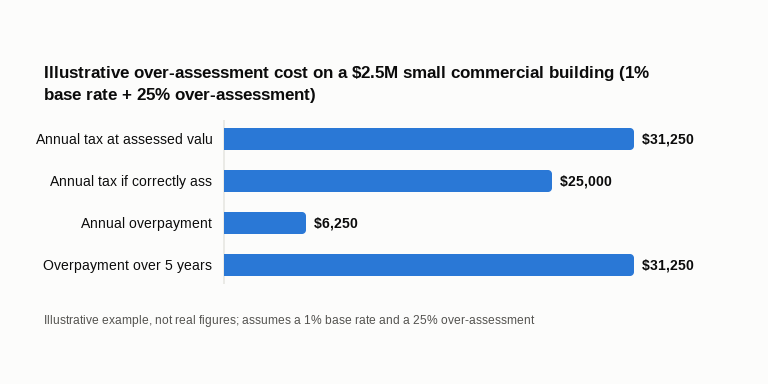
The stakes are easy to underestimate. Take a small commercial building assessed at $2.5 million when a careful analysis puts its market value at $2.0 million. At California's 1% base rate (Prop. 13 sets that base rate, though local bonded debt can push the effective rate slightly higher), the owner pays about $31,250 a year on the inflated figure instead of $25,000. The extra $6,250 repeats every year until the next reassessment or a successful appeal, which under California's reassessment rules may not come for years. Over a five-year span that is roughly $31,250 of overpaid tax on a single small property. The figures above are an illustration, not a real property's tax bill.
This explainer walks through how assessors actually get to a commercial value, in the order a newcomer would ask the questions.
Key takeaways
- California assessors use three approaches—income, sales comparison, and cost—and pick whichever best fits the property type.
- The income approach dominates for apartments, offices, and retail; assessors derive value by dividing net operating income by a capitalization rate.
- Assessed value in California is not the same as market value: Prop. 13 caps annual increases at 2% but reassesses to market on a change of ownership or new construction (the "split roll" rules differ for some commercial changes—see below).
- Most drift from market comes from stale cap rates, optimistic income assumptions, vacancy undercounts, and unadjusted comparable sales.
- California deadlines are firm: the standard window to file an assessment appeal for a given tax year closes September 15, or 60 days after the assessment notice is mailed, whichever is later—but counties and property types vary, so check your county assessor's appeal page.
How does the income approach value commercial property for tax purposes?
The income approach values a property by what it earns: the assessor estimates the property's net operating income and divides it by a capitalization rate to get a value. This is the default method for income-producing property—apartments, office, retail, industrial, self-storage—because buyers of those assets pay for cash flow.
The formula is simple; the assumptions are not. Assessors typically work from a rent roll and operating statements, then adjust:
- Gross income. They may use actual rents or a market rent estimate, and may add or subtract for above- or below-market leases.
- Vacancy and collection loss. A vacancy allowance is subtracted, even if the property was fully occupied that year.
- Operating expenses. Taxes, insurance, maintenance, and management are deducted; mortgage interest and depreciation are not, because they are financing and accounting items, not property-level costs.
- Capitalization rate. Net operating income is divided by a cap rate drawn from market sales of similar properties. A lower cap rate means a higher value.
The California State Board of Equalization publishes the Assessors' Handbook, and its volume on the income approach lays out the accepted methods assessors should follow. That handbook is the single most useful public document for understanding how the math gets built.
Two adjacent pieces are worth reading alongside this one: what triggers a property tax reassessment and filing commercial property tax appeals in California, which cover the events and paperwork side.
Where does the income approach most often drift from market?
The income approach drifts from market mainly through three assumptions: an outdated or too-low cap rate, an optimistic rent or income figure, and an understated vacancy allowance. Any one of these inflates value, and they tend to compound.
A cap rate is the rate of return a buyer expects from a property's income; dividing income by it converts cash flow into value. Assessors frequently pull cap rates from a prior year's sales, or apply an average that doesn't fit the subject's age, location, or lease structure. In a rising-cap-rate market (when buyers demand more return, which lowers values), a stale cap rate holds the assessed value artificially high.
Rent assumptions drift too. An assessor using market rents on a building with below-market leases, or counting income that isn't actually collectible, can overstate net operating income. And a 5% vacancy allowance on a property that historically runs 15% is a value inflation, not a rounding error.
A quick illustration
Suppose a small retail building generates $180,000 in gross potential income. The assessor assumes 5% vacancy ($9,000) and $60,000 of operating expenses, leaving $111,000 in net operating income. At a 5.5% cap rate, the indicated value is about $2,018,000.
If the owner's own analysis—using a 15% vacancy allowance and a 6.0% cap rate supported by recent local sales—produces $153,000 in income, minus $60,000 expenses, the net operating income drops to $93,000. At 6.0%, the indicated value is $1,550,000, roughly $468,000 lower. That is a difference of about $4,680 a year at the 1% base rate. These are illustrative figures chosen to show the mechanics.
How does the sales comparison approach work for commercial assessments?
The sales comparison approach values a property by comparing it to recent, arm's-length sales of similar properties, adjusting the sale prices for differences in size, condition, location, and lease terms. It is the primary method for owner-occupied commercial buildings, mixed-use, and land, and a supporting method for income properties.

The mechanics are more involved than for houses. Adjustments typically move value up or down for:
- Size. Price per square foot is adjusted for the subject's size versus the comp.
- Condition and age. A newer comparable gets a downward adjustment.
- Location. Traffic, visibility, and neighborhood differences are monetized.
- Time. A sale from two years ago is trended forward or backward to the valuation date.
- Terms. Sales involving unusual financing or related parties are discounted.
Drift happens when comparables aren't truly comparable—wrong submarket, wrong building class, wrong lease status—or when time adjustments are skipped. Assessors sometimes rely on a small pool of sales because commercial transactions are sparse, which makes each comp carry more weight than it should.
How is the cost approach used, and when does it overstate value?
The cost approach estimates value as the cost to replace the building with a new one of equal utility, minus depreciation, plus the value of the land. It is used mainly for special-purpose properties—churches, schools, utilities, industrial plants, and new construction—where no reliable income stream or comparable sales exist.
The formula: replacement cost new, less physical deterioration and functional or economic obsolescence, plus land value. Replacement cost is often derived from construction cost manuals and regional multipliers rather than an actual build.
This is where overstatements cluster. Depreciation—especially external obsolescence, the loss in value from forces outside the property like a changing neighborhood or a shrinking industry—is the hardest piece to measure and is frequently understated. An assessor who applies modest depreciation to a 40-year-old special-purpose building can land well above what any buyer would pay.
Which valuation approach applies to which property type, and where does drift happen?
Assessors generally match the approach to the property type, and each match has a predictable failure point. The table below summarizes the pattern; it is a general guide, not a rule, and a given parcel may be valued on more than one approach.

Property type: Apartments (5+ units) — Primary approach: Income — Where values most often drift: Cap rate from older sales; vacancy too low; expenses understated
Property type: Office / retail — Primary approach: Income — Where values most often drift: Market rent applied to below-market leases; stale cap rate
Property type: Industrial / warehouse — Primary approach: Income, with cost and sales as support — Where values most often drift: Rent growth assumed ahead of the submarket
Property type: Owner-occupied commercial — Primary approach: Sales comparison — Where values most often drift: Non-comparable sales; no time adjustment
Property type: Special-purpose (church, plant, utility) — Primary approach: Cost — Where values most often drift: Depreciation and obsolescence understated
Property type: Land and new construction — Primary approach: Cost or sales comparison — Where values most often drift: Land comps from outside the submarket; construction cost inflated
The California context matters here. Prop. 13 limits annual assessment increases to 2% for a property that hasn't changed ownership, so many commercial properties carry assessed values that have drifted far from market—sometimes below it, often above it if the base-year value was set in a strong market and the area has softened. The Assessors' Handbook, available through the California State Board of Equalization, is the reference for how these methods are supposed to be applied, and each county assessor publishes its own procedures. A statewide overview of the assessment and appeal landscape lives on our California resource page.
For broader context on how commercial property is taxed nationally and how state systems differ, the Tax Foundation tracks property tax structure and effective rates across states.
Once an assessment looks over market, the practical question becomes whether a formal appeal is worth the time and evidence. Two reads help frame that decision: why property taxes don't drop even when values do, and is a property tax appeal worth the effort. If an appeal is denied, understanding the refund and escalation path matters too—California's assessment appeals boards and county processes determine both, and the California State Board of Equalization publishes the governing handbook chapters. Proprietors considering whether to self-file or hire help can weigh the tradeoffs in this comparison of a flat fee versus contingency arrangement, and property managers managing appeals across many owners' portfolios will find the workflow angle in turning property tax into another delivered value.
FAQ
What is a capitalization rate in a property tax assessment?
A capitalization rate (cap rate) is the rate of return an investor expects from a property's net operating income, and assessors divide income by it to estimate value. A lower cap rate produces a higher assessed value. Cap rates are drawn from market sales of comparable properties, so their accuracy depends on how fresh and relevant those sales are.
Does California reassess commercial property every year?
No. Under Prop. 13, a property's assessed value rises no more than 2% a year unless there is a change of ownership or new construction, which triggers a reassessment to market value. Some commercial transfers are excluded from reassessment, and rules vary by transaction, so owners should confirm specifics with the county assessor.
How do I know if my commercial assessment is over market?
Compare the assessor's value against what the property would actually sell for, using the same method the assessor applied—usually income. If your net operating income divided by a market-supported cap rate is materially below the assessed value, you have a case worth investigating before the filing deadline.
What is the deadline to appeal a commercial assessment in California?
The standard window closes September 15 or 60 days after the assessment notice is mailed, whichever is later, but the exact rule and form come from your county's assessment appeals board. Missing it usually means waiting a full year, so verify the date with your county assessor early.
Do I need a lawyer to appeal a commercial property tax assessment?
No. California allows owners to file appeals directly with the county assessment appeals board, and many owners do so without counsel. The work is in the valuation evidence—income statements, lease data, and cap rate support—not in legal procedure, unless the appeal involves a complex ownership or exemption question.
Can an appeal lower my taxes for prior years?
Generally no. An appeal adjusts the value for the tax year being appealed; it does not automatically refund earlier years unless a prior appeal or a county correction applies. The refund question depends on the county's process and should be confirmed with the assessor's office.
See if your commercial assessment is over market
If you own or manage commercial property in Sacramento or elsewhere in California, the first step is a valuation check against the assessor's figure before the filing deadline. LowPropTax runs a property valuation model to predict whether an appeal is likely to produce meaningful savings, and its free savings check will show you where your assessment stands relative to modeled market value—you'll see the predicted savings before any commitment, and the flat $199 fee applies only after the model indicates real money is at stake.
Written by Team LowPropTax
Empowering property owners with the data and strategies needed to successfully appeal unfair assessments and achieve permanent tax relief.